
I was recently asked to give a “10-minute talk / presentation” on the Murray-Darling Basin Plan Review at my local PROBUS Club meeting.
Click the image below to view the slides from this presentation.
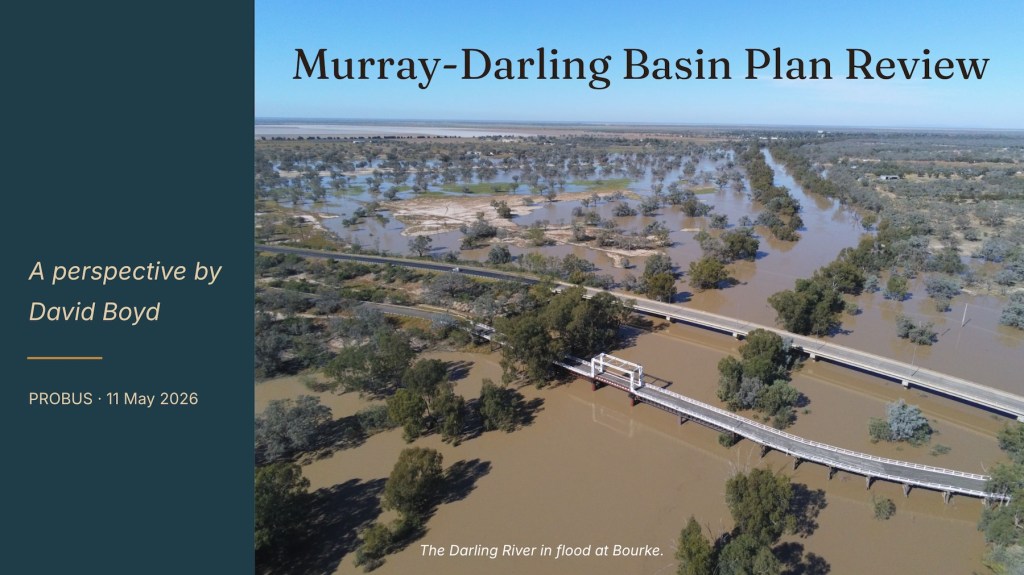
Key Points
- Very topical given the Farrer by-election and the current review of the Plan.
- Overall objective: Sustainably optimise/maximise production to feed and clothe 8B world population.
- Clyde Agriculture was briefly Australia’s largest wool grower, fourth-largest cotton grower, seventh-largest wheat grower, and the largest beef producer in NSW. It was the largest irrigator on the Barwon/Darling River.
- Murray-Darling Basin geography-see slides.
- Only 3% of land irrigated-producing 30% of total value.
- 97% dry land produces 70% of value. Hugely increased by “moisture management” techniques.
- The key characteristic of Australia is the huge variability of rainfall (time and place) and thus river flows. “Droughts and flooding Rains”. It is quite natural for our wetlands at times to be completely dry!
- Darling River average annual flow at Bourke 2,500Gl. Spread ranges from zero (no flow for 12 months) to 12,000GL.
- Minor flood events at Bourke are surprisingly frequent and totally irregular.
- The Mungindi to Menindee reach of the Barwon/Darling River is termed “unregulated”. This term relates to the fact that the flow is not physically regulated by Government dams. It is highly regulated by the Government – area that can be watered, size of pumps, river heights when pumping is allowed, metered take, including maximum annual extractions.
- Variability demands “adaptive management”. Single-figure ‘Sustainable Diversion Limits’ are nonsensical. Too low in wet seasons/too high in droughts. Total annual extractions reflect the variability.
- Entitlements (licenses) give the owner a share of flows to 100% of an upper limit figure. These are tradeable. Allocations vary in line with available water and are also tradeable. Most commonly, well under 100%. An entitlement without an allocation is “phantom water”.
- Beware ‘the illusion of control’. “Nature rules, man fiddles at the edges”.
- Dramatic bad news sells. Good news doesn’t. Floods are mostly welcome and beneficial. The Murray-Darling Basin discussion paper wrongly assumes the rivers are degraded by tightly controlled extractions – “restored”, “decades of over extraction”, etc. Carp/water quality is a genuine problem.
- Snowy Scheme, including the huge Eucumbene Dam, excluded from the Plan.
- We, humans, prefer to blame somebody rather than something. When the rains have stopped and the storages are low, it is still those bastards upstream taking all the water!
- Evaporation is the enemy of water storage – private off-river storages, Menindee Lakes and Lower Lakes in SA. The annual loss is around one metre off the surface area. Deep storages most efficient.
- Major regulatory events- The Cap 1995, National Water Initiative 2004, introducing water property rights and The Plan 2012 – committing $10bn (now $14bn) chasing Green preferences for a forthcoming election. Not even referred to Treasury! The natural impact of drought was branded as “over-allocation and mismanagement”.
- Problem of the ‘barrages’ below Lake Alexandria and the unnatural objective of keeping flows to the ocean 90% of the time.
- Great quote from the former Mayor of Hay (on the Murrumbidgee) – “The Murray-Darling Basin Plan is a solution looking for a problem”.
- When explorer Charles Sturt discovered the Darling River in 1829, it was a series of salty, stagnant water holes, too salty to water his horses. He couldn’t blame the irrigators for that!
To quote Harvard Professor John Briscoe: “The Water Act of 2007 was founded on a political deception….. I would urge the Government to start again”.


