2WEB Radio Interview – 31 January, 2026
Press Play to listen in full.

When Australia Rode on The Sheep’s Back
– David Boyd’s book captures a unique chapter in our history
Click the image below to open full article in PDF.
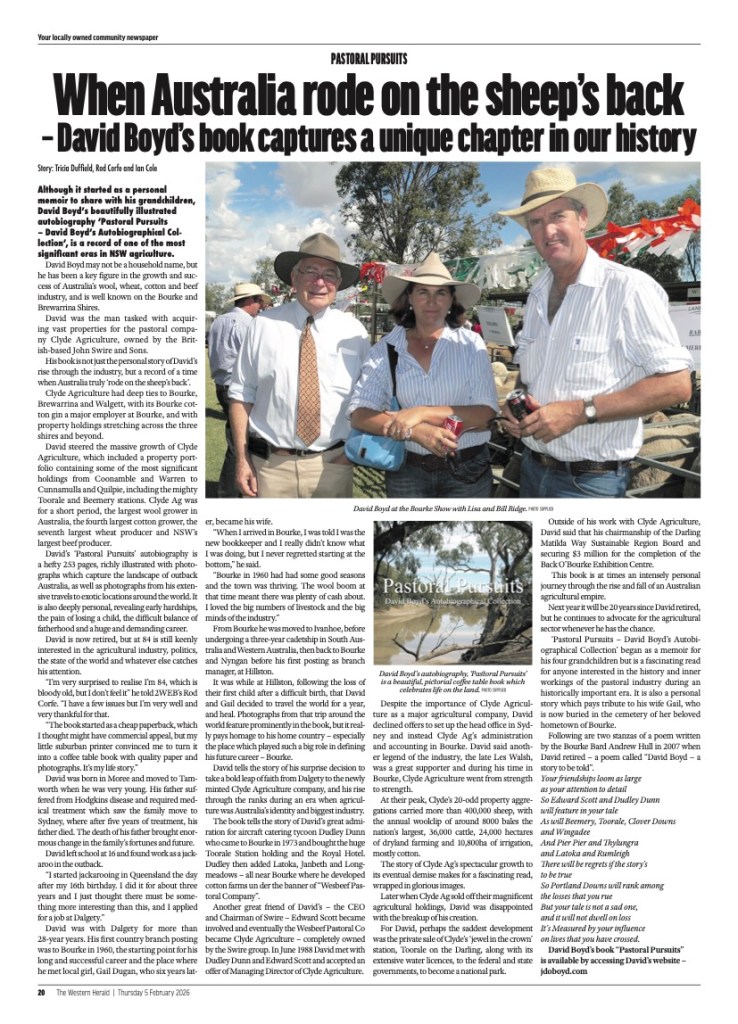
The Western Herald – 5 February, 2026
Outback Magazine – A Very Kind Review
Active Humanity
“As a mentor and a father and a husband and a friend
As a leader and as someone upon whom you can depend
As a steward of the country with a future to unfold
Your place within this country is a story to be told.”
So wrote poet and OUTBACK contributor Andrew Hull of David Boyd to mark David’s retirement as Chairman and Chief Executive of Clyde Agriculture at the end of 2007.
During the 19 years David headed up Clyde he led the growth of the company from a handful of properties at Bourke to a leading agribusiness with some 20 properties/aggregations across NSW and Queensland. Clyde became Australia’s largest woolgrower and a substantial beef, grain and cotton producer. At its height, the properties within the portfolio – such storied holdings as Portland Downs,Brewon,Oxley,Wingadee,Toorale,Beemery and Thylungra- ran around 400,000 sheep, 36,000 cattle, farmed 24,000 dryland hectares and 10,800ha of irrigation.
Throughout the 28 years prior to taking on his role at Clyde, David worked with Dalgety, rising from teenage clerk to general manager of the company’s rural operations.
His wider career engagement saw David serving on the boards of Cotton Australia, the Australian Wool Exchange, Wool International and Australian Wool Innovation. He has been a member of the textiles and footwear advisory committee of the CSIRO and chairman of the Darling Matilda Way sustainable region advisory committee of the Federal Government’s Department of Transport and Regional Services.
All of which speaks to a capability and a work ethic both rare and inspiring. Unsurprisingly, David’s 253-page hard-cover, self-published memoir- Pastoral Pursuits – is an insightful, detailed, well-written and liberally illustrated insider’s account.
More than this, however, it stands as testimony to a life populated by family, love, ambition, tragedy, hard work, intelligence, determination, faith, courage and humility in the face of challenge, adversity and opportunity. As such, it transcends the straightforward recounting of an outstanding agricultural career to become the very personal story of a practical visionary entirely aware of his own humanity.
Outback Magazine – April/May 2025 Issue
Pastoral Doyen reflects – How David Boyd fulfilled a dream
David Boyd has surely lived out the dream of many an aspirational pastoral house employee: the transition from agent to principal – in his case, on a grand scale.
After 18 years with the pastoral firm Dalgetys (now Nutrien), Boyd by 1978 at the age of just 36 had reached the heady position of national general manager, rural division.
His future in the executive ranks of one of Australia’s biggest pastoral firms seemed assured, but such a career path was not to be.
Instead, after six years in the job he was approached with an offer he found too enticing to refuse: heading up the newly-minted pastoral company Clyde Agriculture for its British-based owner, John Swire and Sons.
The offer was made to him by Edward Scott, the chairman and chief executive of Swire’s Australian arm, who saw Boyd as just the man to drive the pastoral expansion for Clyde that he had in mind. It was the British-born Scott who likened Boyd’s career transition, in his typically colourful language, to that of ‘poacher-turned-gamekeeper’ – a line Boyd often delighted in using against himself.
With Scott’s all-important support, Boyd embarked on a program of property acquisitions which, over the next 20 years, built Clyde into an agricultural powerhouse – rivalled then in NSW only by the Kahlbetzer family’s Twynam empire.
From the outset, and in line with Scott’s philosophy, the objective was to acquire only substantial and recognised top-drawer properties: Clyde liked to refer to them as ‘AAA’ properties.
At their peak, Clyde’s 20-odd property aggregations carried some 400,000 sheep (the annual woolclip of around 8000 bales was the nation’s largest), and 36,000 cattle, alongside 24,000 hectares of dryland farming and 10,800ha of irrigation, mostly cotton.
Now the story of Clyde’s spectacular growth, triumphs, disappointments and ultimate demise has been laid out for all to see, in a unique and handsome book self-published by Boyd.
Entitled Pastoral Pursuits – David Boyd’s Autobiographical Collection, the 253-page hard-cover book is less a book and more an album.
Written, as he says in the foreword, primarily with the aim of informing his four grandchildren of his eventful life, the book is also a lively read for anyone interested in pastoral matters, and a valuable trove of industry information.
Early chapters deal with Boyd’s childhood, schooling and three-year stint jackarooing in Queensland before moving on to his 28-year career with Dalgety, which began in Sydney in 1960. His first country branch posting was to Bourke – the setting for so much of his future career – where he met his future wife, Gail (Dugan).
From there he was moved to Ivanhoe, before undergoing a three-year cadetship, which involved a year each in South Australia and Western Australia, then back to Bourke, followed by Nyngan and marriage, then his first posting as branch manager, at Hillston.
It was while at Hillston, following the loss of their first child after a difficult birth, that Boyd took a year’s absence while he and Gail took a world trip. While in Britain he worked with Dalgety’s UK arm.
The rich basalt country south of Walcha where the Youngs lived also left a lasting impression, so much so that 30 years later – armed by then with Swire’s cheque book – Boyd snapped up two nearby properties.
In 1974 Boyd was moved to Dalgety’s head office in Sydney, where he filled a number of executive roles before his aforementioned appointment in 1978 as boss of the company’s rural division.
He and Gail had by then settled in Pymble on Sydney’s North Shore and following his career-switching move to Swires in 1984, Boyd set about building the pastoral empire on which his new boss, Edward Scott – with Swire’s (then) backing – had set his sights.
Starting from the cluster of cotton farms and the vast Toorale Station at Bourke which Swire had earlier acquired from former airline services entrepreneur Dudley Dunn, the expansion began with the 1988 purchase of Merrimba at Warren.
That was followed in 1989 by the post-auction purchase of the sprawling 31,000ha Wingadee on the Castlereagh River for $12.9 million – at the time, the highest price paid for an Australian property.
Other famous-name purchases followed, including Beemery, Brewon, Pier Pier and Oxley in NSW, plus Portland Downs,Thylungra and Clover Downs in Queensland. At its peak, Clyde’s pastoral portfolio extended from Central Queensland south to Trangie, and from Walcha on the Northern Tablelands west to Bourke.
Despite its huge scale, the Clyde empire was run on a management shoestring, with just Boyd and two staffers in Swire’s Sydney office overseeing the pastoral operation, while the cotton division was run separately from Bourke.
Day-to-day management was very much “hands on”. The writer once travelled to a function in the Riverina with Boyd and his wife Gail in the Clyde BMW, and had a ringside seat to observe Boyd “at work”.
In 2002 Clyde, along with everyone else, ran into what became known as the Millenium drought (Boyd claims to have coined the term!), which would last for six years and severely test the company’s resilience. Boyd (backed by Scott, before his sudden death in 2002) decided as a matter of policy to feed the company’s core breeding stock, particularly sheep, knowing how hard it would be to replace them once the drought ended.
The costs of this policy resulted in the company recording heavy losses over the period, and following Boyd’s retirement as chairman and managing director in 2007, a drought-chastened Clyde underwent a drastic change of direction.
A decision was taken to quit the pastoral stations that had been Clyde’s body and soul, and redirect the proceeds into farming (grain producing) properties. However, none could be found at prices acceptable to the Swire board, and instead Clyde was wound up.
The company’s 13 remaining station properties – all but three of which had been expanded during Clyde’s ownership – were progressively sold, some of them to the next generation of pastoral empire-builders such as Paraway Pastoral Company and Australian Food and Agriculture.
For Boyd, the unkindest cut of all was the off-market sale of Clyde’s founding station, Toorale on the Darling, along with its extensive water licences, to the federal and State governments to become a national park. As Boyd said at the time, that sale would never have eventuated on Ed Scott’s watch. Scott was so enamoured of that part of the state that he had bought a station there, Mundiwa, for himself.
Boyd’s book is a chronological record of his life, from childhood to retirement, with multiple chapters on his Dalgety career, his family and travel, and his peak years at the helm of Clyde. Later sections deal with Boyd’s active involvement in industry affairs, through his various roles with Wool International, Australian Wool Innovation and Cotton Australia, among others.
The result of nearly a decade of preparation, the book also contains various opinion pieces written by Boyd on matters close to his heart and items written by others, with relevance to his career.
Notwithstanding his career successes, Boyd’s life had its downsides, which he deals with in the book: the deaths of both parents before he was 20, the loss of Gail’s first child at birth, a road accident that left a daughter handicapped, his own brush with cancer, and the Alzheimers that marred the final years of Gail’s life.
Now 83, Boyd recently downsized from his long-held family home and today lives in a nearby unit, with his son and two daughters and their families close by. He maintains contact with many of his former colleagues and staff from both Dalgety and Clyde, and jumps at any opportunity to head back to his former rural stamping grounds.
Liberally illustrated with photos, the large-format, hard-cover book contains histories and production profiles of all Clyde’s properties plus sections on water (with detailed maps), cricket (a Boyd passion) and a lengthy appendix covering a range of issues.
Peter Austin, The Land – 23 May, 2024
An Addition to The Library
There’s an old saying that you can judge a person’s character by browsing the style of the books in their personal library.
Mine, for example, contains only a half dozen or so. They include Sheep: Their Breeds Management and Diseases by William Youatt (1859); On the Sheep’s Back by Ronald Anderson; Kidman: The ForgottenKing by Jill Bowen; Out of the West by Dick Condon; They Struck Opal by E.F Murphy (1948); Henry Lawson Prose Writings, Edited by Prof. Colin Roderick; The Dictionary of Australian Quotations; and Transported to Paradise, A Genealogy of Ann Forbes by Prof. Douglas Huxley (My convict ancestor from the First fleet).
This clearly indicates a penchant for the bush, that vast expanse beyond all urban boundaries, its history, and the people who helped create it.
I’ve just added another book entitled “Pastoral Pursuits” – David Boyd’s Autobiographical Collection, 253 pages of priceless text and photographs, nostalgically tracing his career from boyhood to manhood, schooldays to retirement, and fountain pens to Apple Pens.
His commitment to, and passion for, the bush and individual segments of it, comes to the fore, interwoven with agro-politics, agribusiness and the fluctuation fortunes of Australian agriculture and the people who were an integral part of that.
In intricate, intriguing and meticulous detail, he traces his decades long involvement with Dalgety and 20-year adventure with Clyde Agriculture for its British-based owner, John Swire and Sons, building a rural empire similar, and in many instances superior, to Sir Sidney Kidman and John Kahlbetzer’s TwynamGroup, comprising 400,000 sheep, an annual wool clip of around 8000 bales, 36,000 cattle, 24,000 hectares of dryland farming and 10,800ha of irrigation, mostly cotton, in NSW and Queensland.
As previewed in The Land this week by Peter Austin, it tells the graphic history of Clyde’s spectacular growth, triumphs, disappointments and ultimate tragic, untimely, preventable and regrettable demise.
In the process, it provides a treasure trove of complementary historically-valuable information including anecdotes, personalities, photos, maps and data relevant not only to his personal, Dalgety and Swire’s pursuits, but the rural sector as a whole over some 65 years.
David Boyd has an obvious passion for the bush, its people, its policies and its progress. He embraces it with affection and admiration bordering on adoration. As they say in the Classics: “You can take the boy from the bush, but you can’t take the bush from the boy.”
While it provided him with sustenance, employment and obvious enjoyment, it also endowed him with immense knowledge and skills, which he willingly and enthusiastically shares in this autobiography.
While his legacy has deliberately been under the radar, importantly, what he has taken from the industry, he has given back. He has served on the Boards of Cotton Australia, the Australian Wool Exchange, Wool International, Australian Wool Innovation, Tandou Limited, Dekalb Shand, and the NSW Stock Agents Association.
He has also been a member of CSIRO’s Textiles and Footwear Advisory Committee, Chair of the McGarvie Smith Institute, and the Government’s Darling Matilda Way Sustainable Regions Advisory Committee.
He is also a hyperactive member of Agriminds, a small group of senior agribusiness executives, mostly retired, who meet monthly to pool a wealth of knowledge on food and fibre production, processing, marketing, retailing and exporting, via discussion, debate and contributions from guest speakers, dedicated to solving the continuously evolving problems and opportunities of the agribusiness landscape.
Not a bad record for a bloke who left school with an intermediate certificate aged 16, who joined Dalgety as a cadet clerk in 1960, and became its national General Manager – Rural Division only 18 years later. “Pastoral Pursuits” is available from a limited print-run for $125 plus postage. Contact the author at jdoboyd@gmail.com or phone 0429 999 444. He might even sign a copy, if he’s not absorbed in the cricket at Lord’s or The Oval.
Trevor Johnston, Cotton Wire – 28 May, 2024

 David Boyd's Blog
One thought on “Pastoral Pursuits – Reviews”